ELECTRICAL SAFETY · ARC FLASH
When an Incident Happens Tomorrow - Can You Prove Your Controls Were Adequate Today?
Craig Phillips | Owner & Director, Lowen Glas · Co-Director, Arc Guard Ltd
Written in association with Transmag UK
“It’s not guilty until proven innocent - it’s risk proven, now justify your controls.”
In my previous article, Arc Flash: From Incident Back to Prevention, I explored why defensibility, not just energy levels and PPE categories, is the right frame for arc flash risk management. Most conversations in our industry open with incident energy calculations and protection boundaries. That is important work, but it sidesteps the prior question: if an incident occurred today, could you demonstrate that your controls were proportionate, documented, and consistently applied?
That question doesn’t stop at the engineering team. It lands equally on the organisation, the responsible persons, and the individuals who signed off on procedures.
The operational pressure that creates the gap
Industrial electrical engineers are under constant pressure to keep plant operational, maintain production output, and minimise downtime. Under those conditions, it is entirely understandable that critical elements of electrical safety management can fall behind, not from negligence, but from the cumulative weight of competing demands.
What that pressure can produce, over time, is a gap between the controls that exist and the evidence that those controls were applied. Incomplete maintenance records. Risk assessments that haven’t kept pace with plant changes. Insufficient documentation of who accessed what, and when.
| THE EXPOSURE When an electrical incident arises, the absence of clearly documented evidence, inspection records, risk assessments, access logs, compliance sign-off, can make it extremely difficult to demonstrate that appropriate controls were in place. That absence exposes both the organisation and individuals to operational, legal, and safety risk under the Health & Safety at Work Act 1974, the Electricity at Work Regulations 1989, and the Management of Health & Safety at Work Regulations 1999. |
Introducing the Transmag Safe Access Panel
Transmag UK is a global leader in advanced measurement, instrumentation, and protection technologies, with a specialist focus on arc flash safety solutions for low and medium voltage switchgear and substation assets. Their work addresses a consistent challenge in industrial and renewable energy sectors: the management of remote LV and MV switchgear and substations, including the control of maintenance activity, contractor safety, and the associated business risk.
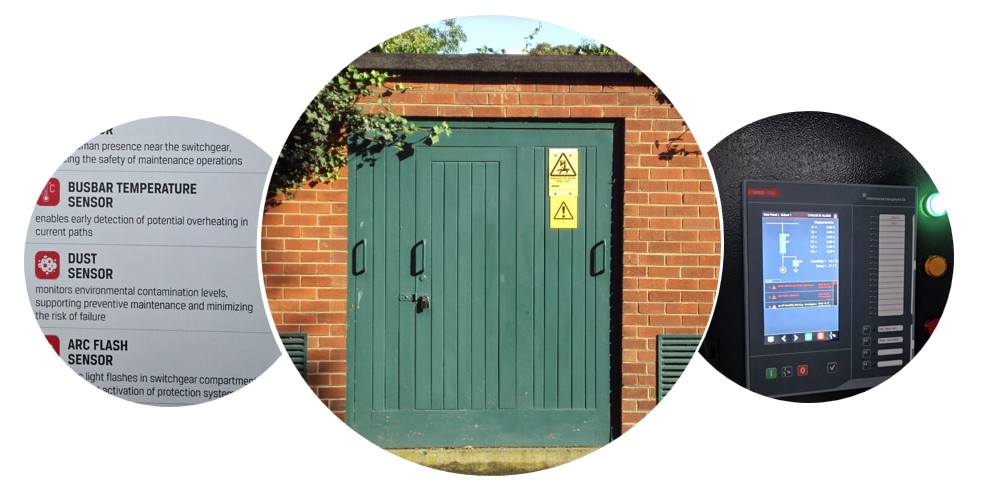
Building on an established range of system-based and retrofit arc flash protection solutions, Transmag UK has now launched the Safe Access Panel (SAP), a solution that brings together arc flash protection limiting incident energy to no more than 8 cal/cm², substation access control, user compliance documentation, and condition-based monitoring in a single integrated system.
What the system delivers
- Substation access control: Managed entry and exit logging for substations and switchgear enclosures, with full audit trail.
- User compliance sign-off: Formal acknowledgement records at the point of access — documented evidence that procedures were followed.
- Condition-based monitoring: Continuous monitoring of temperature, humidity, and partial discharge — the early indicators of developing faults.
- Cyber-secure communications: Data transmission designed to meet the security requirements of critical infrastructure environments.
- Regulatory data capture: Captured records structured to support compliance obligations under HASAWA, EAWR, and MHSWR.
- Contractor oversight: Visibility of who is working where, and confirmation that safety procedures have been acknowledged.
- Arc flash protection: Integrated arc flash protection limiting incident energy exposure to no more than 8 cal/cm² — protecting both operators and switchgear assets in the event of an arc flash incident.
From protection to defensibility
The Transmag Safe Access Panel represents an important development in how we think about arc flash risk management. Protection, whether through detection systems, current limiting, or PPE addresses what happens during an arc flash event. Defensibility addresses whether you can prove, after the fact, that your duty of care was exercised before it.
Condition-based monitoring data, access logs, and compliance sign-off records are not just operational tools. They are evidence. They are the documentation that answers the regulator’s question, the insurer’s question, and in the most serious cases, the court’s question: what did you know, and what did you do about it?
The Safe Access Panel integrates that evidence generation into the normal rhythm of managing your assets, not as an additional administrative burden, but as a natural output of a system that is already doing its monitoring and access-control work.
For organisations managing remote or distributed LV and MV switchgear, in manufacturing, utilities, data centres, renewables, or facilities management, this kind of integrated approach is increasingly the difference between a defensible safety case and an exposed one.
Lowen Glas works with Transmag UK to bring these solutions to clients across the UK. If the question of documented controls and arc flash defensibility is relevant to your organisation, we’d welcome the conversation.
Regulatory context: HASAWA 1974 · EAWR 1989 · MHSWR 1999 · IEC 60947-9-2 · BS 7671 · IEEE 1584