ARC FLASH SAFETY · CONDITION-BASED MONITORING · WRITTEN IN ASSOCIATION WITH TRANSMAG UK
The arc flash incident that shouldn’t happen - because the warning signs were always there
Craig Phillips | Owner & Director, Lowen Glas · Co-Director, Arc Guard Ltd
Most arc flash strategies wait for the energy to exist before they act. Condition-based monitoring changes the question entirely, from “how do we survive the arc?” to “why would we let conditions reach the point where one is possible?”
Arc flash has a cause. It is not a random event. Behind the vast majority of arc flash incidents is a traceable chain: an insulation system under thermal stress for months; partial discharge activity that steadily eroded dielectric integrity; a humidity profile that shifted the risk curve long before any person approached the switchgear. The signs were present. They simply weren’t being observed.
This is the foundational problem with how arc flash risk is typically managed. The energy calculation tells you what will happen if an arc occurs. The PPE category tells you what to wear if it does. Neither addresses whether an arc should be considered likely in the first place and neither captures the data that would let you intervene before the conditions mature.
Protection without prevention is a permanent state of emergency. You are managing consequences because you have chosen not to manage causes.
THE CAUSAL PATHWAY
Faults don’t arrive without warning
In most electrical plant failures, the physical environment inside the switchgear gives advance notice often weeks or months before a fault develops to the point of creating an arc flash hazard. The challenge is that traditional inspection and maintenance cycles are too infrequent, and too dependent on access, to catch these signals reliably.
The causal pathway from a developing fault to an arc flash event passes through a detectable intervention window. Condition-based monitoring occupies that window. When sensors are continuously observing temperature, humidity, and partial discharge activity, the developing fault is no longer invisible it becomes a data trend that maintenance teams can act on before conditions that create arc flash risk are ever reached.
| Stage | What is happening | CBM role |
| Developing fault | Insulation degradation, contamination ingress | Baseline deviation detected |
| Environmental shift | Temperature rise, humidity ingress | Threshold alert triggered |
| Intervention window | Asset shows measurable warning signals | Planned maintenance actioned |
| Partial discharge | Dielectric breakdown begins | PD activity logged and escalated |
| Arc flash event | Full fault condition if undetected | Prevented if earlier stages acted on |
WHAT CBM OBSERVES
The three early-warning signals
Each of the following signals, on its own, warrants attention. Together they form a risk profile for an individual asset, one that changes over time, responds to operational conditions, and gives maintenance teams a basis for prioritising interventions grounded in the actual state of the equipment, not a fixed calendar schedule.
Thermal anomaly
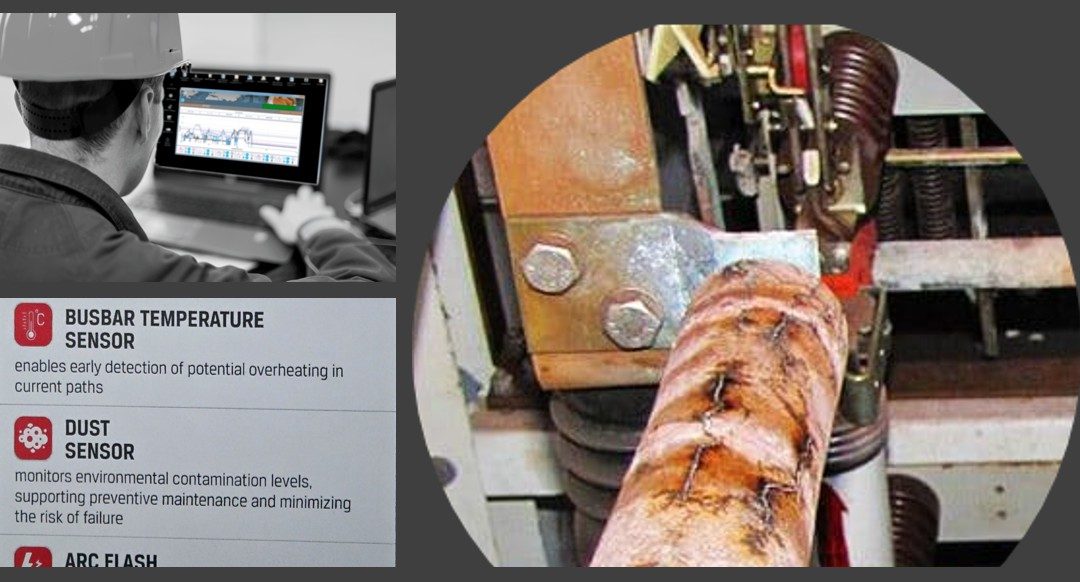
Rising temperature profiles in switchgear enclosures indicate resistance changes, poor connections, or overloaded conductors, all precursors to insulation failure. A sustained upward trend in thermal data is one of the clearest indicators that an asset is approaching a fault condition.
Humidity ingress
Elevated or fluctuating humidity inside enclosures accelerates insulation degradation and dramatically increases the likelihood of surface tracking and partial discharge. Remote substations and outdoor-installed switchgear are particularly exposed to this risk, especially through seasonal variation.
Partial discharge activity
Partial discharge is the direct signature of dielectric breakdown in progress. Continuous PD monitoring identifies this activity long before it progresses to a full fault condition providing the most direct available signal that arc flash risk is actively developing within an asset.
FROM REACTIVE TO ANTICIPATORY
Why scheduled maintenance is not enough
Fixed-interval maintenance has real value, but it operates on a fundamental assumption: that the condition of an asset is adequately represented by its state at the last inspection point. In a stable, low-demand environment that may be defensible. In the environments where arc flash risk is highest remote substations, high-utilisation switchgear, assets exposed to variable environmental conditions that assumption fails regularly.
An asset that was clean and dry at the last annual inspection may have experienced humidity ingress, thermal cycling, and measurable partial discharge activity in the intervening months. Without continuous monitoring, none of that is visible. The maintenance schedule suggests the asset is in good order. The asset is not in good order.
A maintenance schedule tells you when you last looked. Condition-based monitoring tells you what is happening right now.
The practical consequence is that scheduled maintenance, however diligently applied, cannot substitute for continuous observation of the signals that precede arc flash events. It can complement that observation but it cannot replace it.
INTEGRATED APPROACH
The Transmag Safe Access Panel
Building on its established range of arc flash protection solutions, Transmag UK has developed the Safe Access Panel, a system that integrates condition-based monitoring with access control, user compliance documentation, and arc flash protection in a single platform. For organisations managing remote or distributed LV and MV switchgear, it is designed to make causal monitoring and operational controls part of the same workflow rather than separate activities.
- Continuous condition monitoring — temperature, humidity, and partial discharge observed in real time, providing the primary early-warning data stream for developing fault conditions that precede arc flash events.
- Arc flash protection — integrated protection limiting incident energy exposure to no more than 8 cal/cm², maintaining consequence control alongside cause monitoring.
- Substation access control managed entry and exit logging with full audit trail, ensuring access events are recorded in the context of the asset’s monitored condition at that moment.
- User compliance sign-off — formal acknowledgement records at the point of access, timestamped against the current environmental and electrical condition profile of the asset.
- Cyber-secure communications — data transmission designed for critical infrastructure environments, supporting integration with remote monitoring platforms.
The significance of combining these elements is that condition data and the operational record are generated together. The compliance record is timestamped against a known condition profile. This is not an administrative benefit it is a risk management benefit. The causal picture and the operational picture are the same picture.
A DIFFERENT CONVERSATION
Reframing arc flash risk management
The industry conversation about arc flash has matured considerably. Incident energy analysis is now well understood. PPE selection frameworks are established. Protection technologies have improved substantially. But for all that progress, the dominant question in most organisations remains a consequence question: if an arc occurs, what are our mitigations?
Condition-based monitoring is an invitation to ask the prior question: what conditions make an arc flash event more or less likely and are we monitoring them? That question is answerable. The data exists or can be made to exist. And the intervention window, once a developing fault is detectable in sensor data, is often wide enough to act well before any human exposure is necessary.
This is where electrical safety management has the most room to develop. Not in better PPE, the current standards already provide strong protection. Not in faster detection, existing protection technologies perform well. But in the systematic observation of the causal conditions that precede arc flash events, and in building the operational discipline to act on what those observations reveal.
Talk to Lowen Glas about condition-based monitoring
Lowen Glas works with Transmag UK to bring these solutions to clients across the UK. If your organisation manages remote or distributed LV/MV switchgear and you want to explore what continuous asset monitoring looks like in practice, we’d welcome the conversation.
Regulatory context: HASAWA 1974 · EAWR 1989 · MHSWR 1999 · IEC 60947-9-2 · BS 7671 · IEEE 1584