Arc Flash: From Incident Back to Prevention
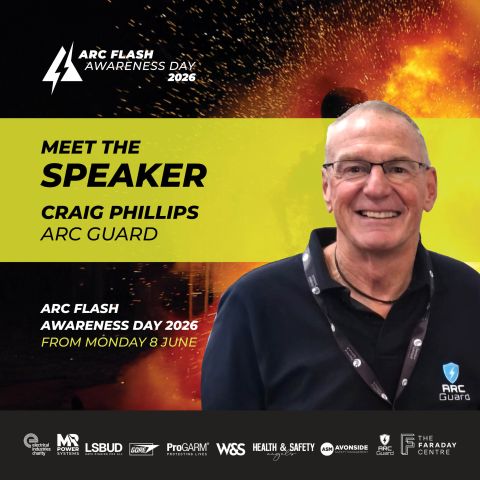
Category: Electrical Safety · Arc Flash Author: Craig Phillips — Owner & Director, Lowen Glas · Co-Director, Arc Guard Ltd Event: Arc Flash Awareness Day 2026
"If this happened in your organisation today — would you be able to defend your decisions?"
Arc flash is foreseeable. The standards exist. The controls exist. The technology exists. And yet, year after year, engineers are injured — and organisations find themselves on the wrong side of an HSE investigation — not because they didn't care, but because they didn't connect what they knew to what they did. This session aims to change that.
What follows is drawn from the Arc Flash Awareness Day 2026 presentation, Arc Flash: From Incident Back to Prevention. It walks through a realistic training scenario, examines how the HSE investigates an electrical incident, and builds a defensible framework for risk reduction — one that duty holders at every level can use in practice.
Why Defensibility Is the Right Frame
Most conversations about arc flash start with energy levels and PPE categories. That's important, but it misses the prior question: if an incident occurred today, could you demonstrate that your controls were proportionate, documented, and applied?
"It's not guilty until proven innocent — it is 'risk proven, now justify your controls.'" — Craig Phillips, Arc Flash Awareness Day 2026
In UK health and safety law, once the prosecution establishes that a foreseeable risk existed, the burden shifts to the duty holder to show they took all reasonably practicable steps. That burden falls on everyone who had control over the risk: business owners, duty holders, installation personnel, maintenance staff, designers, and workers alike.
The chain — primary legislation (HASAWA 1974) → secondary legislation (EAWR 1989, MHSWR 1999) → standards (BS 7671, BS EN IEC 61439) — isn't just a hierarchy of documents. It's your evidence base. Compliance with recognised standards is how you demonstrate you met your obligations, not simply how you prove good intentions.
Key Distinction: Not everything is legally binding. Primary and secondary legislation create legal duties. Standards, codes of practice, and guidance documents describe how to meet those duties. Understanding which is which matters — especially under investigation.
A Training Scenario: The Hidden Hazard
To make this concrete, consider the following scenario — used throughout the Arc Flash Awareness Day 2026 session as a teaching case.
Task: Install and terminate a new 185 mm² steel wire armoured (SWA) cable LV feeder into an existing IEC 61439 Form 4 Type b switchboard. The busbars and other outgoing ways are to remain energised — no full shutdown has been permitted. The work therefore falls under EAWR Regulation 14: work on or near live conductors.
The hidden hazard: The installation team assumes that Form 4 Type b segregation — which provides physical separation between functional units — is equivalent to a safe working arrangement. It isn't. IEC 61439 Form 4b is a design classification, not a live working permission.
The gap: On an adjacent circuit breaker, a missing barrier plate and absent terminal shields expose energised terminals on a neighbouring circuit. The missing plate is only visible from a very specific angle. The pre-task inspection misses it. The toolbox talk doesn't prompt engineers to look for it.
The event: Two engineers manoeuvre the heavy, stiff cable into position. The cable flexes unexpectedly. A loose armour strand brushes two phased terminals on the adjacent circuit breaker. A phase-to-phase fault initiates. The arc vaporises copper, generates plasma and a pressure wave, and ignites insulation debris inside the chamber. The main ACB trips. Part of the site is down. Both engineers suffer temporary hearing loss. The cabling engineer — in PPE — has his hands and face protected. His colleague, who came to assist without PPE, suffers minor burns.
The scenario is fictional, but every element of it is drawn from real failure patterns. The hazard is present. The team is exposed. The incident is — as the presentation puts it — now a matter of when, not if.
How the HSE Investigation Unfolds
After an injury incident involving arc flash, the HSE process is structured and methodical. Understanding it in advance isn't about gaming the system — it's about knowing what evidence you need to have, and what its absence signals.
The investigation proceeds in five stages:
1. Notification and jurisdiction. RIDDOR logging and HSE contact. Fatal or specified injuries require immediate telephone notification — not just online submission.
2. Scene management. An inspector is deployed. The scene is locked down. Isolation, prevention of re-energisation, and cessation of live work are verified before anything else proceeds. Critically, the employer has a parallel duty to secure the scene — not just the inspector.
3. Evidence gathering. Physical evidence, witness accounts, and documentary evidence — permit to work records, risk assessments, training records, maintenance logs — are collected in parallel, before the compliance lens is applied.
4. Compliance review. Evidence is assessed against BS 7671, EAWR Regulations 4, 14 and 16, HASAWA, and MHSWR.
5. Enforcement and decision. Based on findings, enforcement action — Prohibition or Improvement Notice — is considered, and a decision is made in conjunction with the CPS on whether to pursue prosecution.
Legal exposure: The Corporate Manslaughter and Corporate Homicide Act 2007 and the Health and Safety (Offences) Act 2008 sit alongside HASAWA 1974 as primary legislation. The consequences of an undefended incident extend well beyond a fine.
Where the Controls Failed: A 5-Why Analysis
Applying the NEBOSH 5-Why model to the scenario above, the failures operate at four levels:
Procedural: The PTW and risk assessment never challenged the assumption about live busbars and outgoing ways. EAWR Reg. 14 requires documented justification for proximity work near energised conductors — and it was absent.
Managerial: Form 4 Type b segregation was treated as a safety guarantee. Safety process and engineering judgement were not applied to the actual installed condition. One engineer worked in PPE; his colleague did not, and was injured.
Technical: No arc flash study had been conducted. Incident energy levels and arc flash boundaries were unknown. No dedicated arc flash protection system was in place to limit arc duration or reduce incident energy.
Human factors: The missing barrier plate was only visible from a specific angle. The pre-task inspection missed it. The toolbox talk did not prompt engineers to look for it.
None of these failures required extraordinary negligence. Each one is an entirely recognisable pattern — familiar from real sites, real audits, and real conversations about why things didn't get done.
Managing Risk: Hierarchy of Controls and ALARP Together
The two frameworks that govern UK risk management are often treated separately when they work best together.
The Hierarchy of Controls (required by MHSWR 1999, Regulation 3) gives you the strategy: eliminate the hazard, substitute, apply engineering controls, then administrative controls, and use PPE only as a last resort. In the context of electrical safety:
- Level 1 — Elimination: De-energising equipment. Locking off and proving dead before work begins.
- Level 2 — Substitution: Eliminating live work by upgrading or replacing the equipment or system.
- Level 3 — Engineering Controls: Design-based or physical safeguards that reduce the likelihood or severity of arc flash.
- Level 4 — Administrative Controls: Procedural and management-based measures that influence how people work.
- Level 5 — PPE (last resort): Protects workers from hazards not fully eliminated by higher-level measures. Required — but never a substitute for the controls above it.
ALARP — As Low As Reasonably Practicable — gives you the decision test: how far must you go? The answer is: reduce risk as much as you reasonably can, but not to the point where the cost in time, money, or effort is grossly disproportionate to the benefit gained. The highest reasonably practicable level of control must always be used.
From Theory to Practice: A Risk Reduction Map
The presentation sets out a practical matrix of arc flash risk reduction measures, mapped against implementation cost and risk reduction impact. Three categories emerge:
Baseline — Establish These First
Health and safety policies and procedures; equipment labelling; arc flash PPE to appropriate cal/cm² ratings; and a training programme. Without these, nothing else lands effectively.
Quick Wins — High Impact, Manageable Cost
Arc flash relays, arc flash retrofit panels, a no-live-work policy, a formal arc flash study, maintenance mode switching (EMES), and digital Safe Systems of Work and Standard Operating Procedures. These deliver meaningful risk reduction at proportionate cost and form the backbone of a defensible programme.
Strategic Investments — For Complex Environments
Zone selective interlocking; remote switching and racking; arc quenching and suppression; condition-based monitoring with arc flash integration; partial discharge monitoring; and busbar differential protection. These are appropriate where incident energy levels, system criticality, or operational constraints demand it.
Within this framework, a subset of measures — arc flash relays, zone selective interlocking, arc flash retrofit panels, arc quenching and suppression, busbar differential protection — operate autonomously to interrupt or suppress an arc event. The presentation introduces the term Direct Acting Risk Mitigation (DARM) for this class, distinguishing them from controls that depend on human action in the moment.
The Closing Argument
"The law doesn't ask you to eliminate uncertainty. It asks you to manage foreseeable danger. Arc flash is foreseeable. The standards exist. The controls exist. The technology exists." — Craig Phillips, Arc Flash Awareness Day 2026
The purpose of working through a scenario — through the hidden hazard, the arc event, the investigation, the failure analysis — is not to assign blame. It is to give duty holders the thinking framework to act before the incident, not after it.
Defensible decisions aren't about perfect systems. They are about proportionate, documented, reviewed controls — applied with engineering judgement to the actual installed condition, not the assumed one.
That is the standard the law expects. And it is achievable.
Would you like a complimentary video briefing on arc flash risk management, arc flash studies, or the arc flash protection technology available for your site?
For the "Arc Flash Awareness Day 2026" presentations go here
Contact Craig Phillips via arcguard.co.uk or lowenglas.co.uk
Craig Phillips — Owner & Director, Lowen Glas · Co-Director, Arc Guard Ltd Arc Flash Awareness Day 2026 · Arc Flash: From Incident Back to Prevention